|
India Facts History
|
||||||||||||||||
|
Passage to India • Overview • Dateline of Events • Time Periods • Geography • Economy • Polity • Religion • Festivals • Languages • Dress • Travel Tips • Special Features | |||||||||||||||
Medieval history is marked by the Turkish invasion, followed by the formation of the Delhi Sultanate by the establishment of the Slave dynasty followed by the Khiljis, the Tughluqs, Sayyids and Lodhis.
 British Indian history encompasses the establishment of the East India company, the first independence struggle in 1857, followed by British Raj, the rise of the Indian National Congress, the Jalianwala Bagh massacre, Mahatma Gandhi's independence initiatives including the salt march to Dandi, the Quit India movement and the final transfer of power to independent India. Modern Indian history includes the trauma of partition and the aftermath of the creation of India and Pakistan. It is about India's post-Independence struggles and achievements and it's recognition in the international forum as a secular democracy that has made the transition to a mature economy, and is now focusing it's energy on the dynamics of an unlimited potential for growth.
Compiled by Romola Butalia
|
||||||||||||||||
 |
||||||||||||||||
Editor: Romola Butalia (c) India Travelogue. All rights reserved. |
||||||||||||||||
 Few countries in the world have roots that stretch back in time to
pre-recorded history. The earliest human activity in the Indian
sub-continent can be traced back to the early, middle and late Stone
Ages (400,000-200,000 BC). Implements from all three periods have
been found in Rajasthan, Gujarat, Bihar, parts of what is now
Pakistan and the southernmost tip of the Indian Peninsula.
Few countries in the world have roots that stretch back in time to
pre-recorded history. The earliest human activity in the Indian
sub-continent can be traced back to the early, middle and late Stone
Ages (400,000-200,000 BC). Implements from all three periods have
been found in Rajasthan, Gujarat, Bihar, parts of what is now
Pakistan and the southernmost tip of the Indian Peninsula.
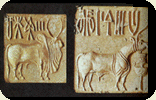 Ancient Indian history includes the pre-historic period, the Indus
valley civilisation, the Vedic and epic ages and a period of
transition when Mahavira and Buddha lived. The emergence of the
Mauryan empire followed thereafter ending in a series of invasions,
the rise of the Deccan kingdoms and the Gupta dynasty followed by an
age of fragmentation into smaller kingdoms that eventually led to
the reign of Harshavardhana. In the south the rule of the Chalukyas,
Pallavas & Pandyas were followed by the Cholas and in the North the
invasion of Mahmud of Ghazni leads us into the medieval history of
India.
Ancient Indian history includes the pre-historic period, the Indus
valley civilisation, the Vedic and epic ages and a period of
transition when Mahavira and Buddha lived. The emergence of the
Mauryan empire followed thereafter ending in a series of invasions,
the rise of the Deccan kingdoms and the Gupta dynasty followed by an
age of fragmentation into smaller kingdoms that eventually led to
the reign of Harshavardhana. In the south the rule of the Chalukyas,
Pallavas & Pandyas were followed by the Cholas and in the North the
invasion of Mahmud of Ghazni leads us into the medieval history of
India.